
Sometimes, all it takes is a new challenge to see what you can create. We’ve gathered some of our favourite art challenges in one place to help you step outside your comfort zone, try something new, and let your creativity take over.
Telepathy Drawing Challenge
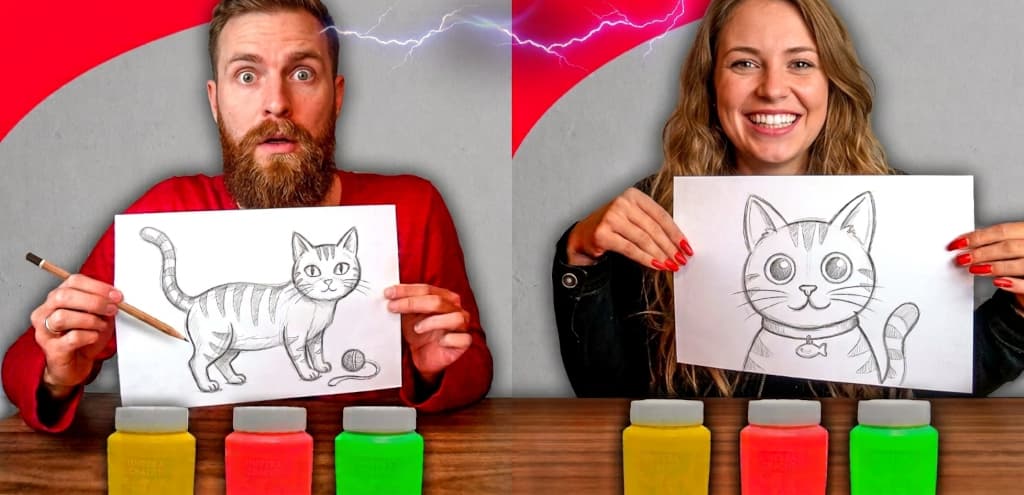
This is a popular art challenge, especially big on YouTube, where two people, sometimes twins, try to draw the same thing without communicating. This is called Telepathy Drawing. The two sit back-to-back or in separate rooms so neither can see the other’s paper. They either pick from a shared theme or go in completely blind. After they finish, they flip their drawings and compare them.
The idea goes back to early laboratory experiments in telepathy. In Mental Radio (1930), American writer Upton Sinclair documented experiments he carried out with his wife over three years. Of 290 drawings, 65 were judged successful matches and 155 were considered partial successes. A later analysis by psychical researcher Walter Prince concluded that the results greatly exceeded chance.
Such exercises can help you master the art of telepathy in practice while sharpening your drawing skills.
Drawing mainly uses the right hemisphere, and the same mechanism works in telepathy. You can even try it without a partner using a special program. Create a set of thoughts and record them by thinking into a microphone instead of speaking. The program then plays them back, and you draw what you perceive. Start with simple subjects like plants, the sky, or nature. When you’re done, the program shows you whether you got a hit or a miss. For the best results, practice telepathy after a good drawing session, when you feel focused and have a strong positive feeling.
At the same time, this practice sharpens your drawing skills. You’ll start creating clearer, more universal images that people can understand across minds. This is literally how professional illustrators and logo designers think.
Redraw Challenge
It’s easy to forget how much our skills can evolve. One of the best ways to see your improvement and how your style has changed is by redoing something you made a long time ago.
You’ll probably like seeing how some things stayed the same, some things you did in the past that you actually prefer to what you do now, and some things you like more about your current style. It’s always interesting to see how you used to draw compared to the way you draw now. Besides, you may find that doing these redraws gives you such a boost in confidence and makes you feel more sure about your skills.
Redraw challenge helps you see your progress, notice things you still need to work on, and build confidence by comparing your old and new artwork side by side.
1-Minute Sketching
The next interesting challenge where you learn to forget about paying attention to every detail is 1-Minute Sketching.
At first, your sketches may look messy or even a little exaggerated, but with enough practice, this will change. You’ll start getting better at making quick decisions and capturing a pose faster. It will also help you get out of those situations when you get stuck on details too much. Instead, you’ll become more confident with quick lines and learn to capture the main idea of a pose faster.
Blind Contour Drawing
Another challenge is to try to draw the outline of an object while constantly looking at it and never looking down at your paper. Blind Contour Drawing challenges your ideas about what makes a good drawing and makes you do something interesting. It can look strange or completely different from what you expected, but that’s the point. It will help you understand that good art isn’t really about making a perfect drawing.
Words Into Drawings Challenge
Another interesting challenge is putting words into drawings. Pick a random word and try to turn it into a picture without thinking too much about what it is supposed to look like.
You’ll see that a simple word can lead you to a completely unexpected idea. You may start with one image in your head and end up drawing something totally different. It’s also interesting to see how the same word can inspire completely different drawings depending on the person.
Color-to-Value Challenge
Take a full-color image and try to translate it into black and white, focusing on the light and dark areas instead of the actual colors.
Try different types of images, including bright high-key photos, dark low-key scenes, strong light-and-shadow contrasts, and ordinary everyday pictures. With practice, you’ll get better at recognizing value relationships and understanding how light and dark work together. This is also a common exercise in art and design classes.